

South Asia: coral bleaching heat stress
How close the corals of South Asia are to bleaching: NOAA satellites compare the water at its 10 reef areas with each reef's normal summer peak, add up the extra heat over the last 12 weeks and give each reef an alert level. Figures for November 20, 2026, updated once a day. How to read it
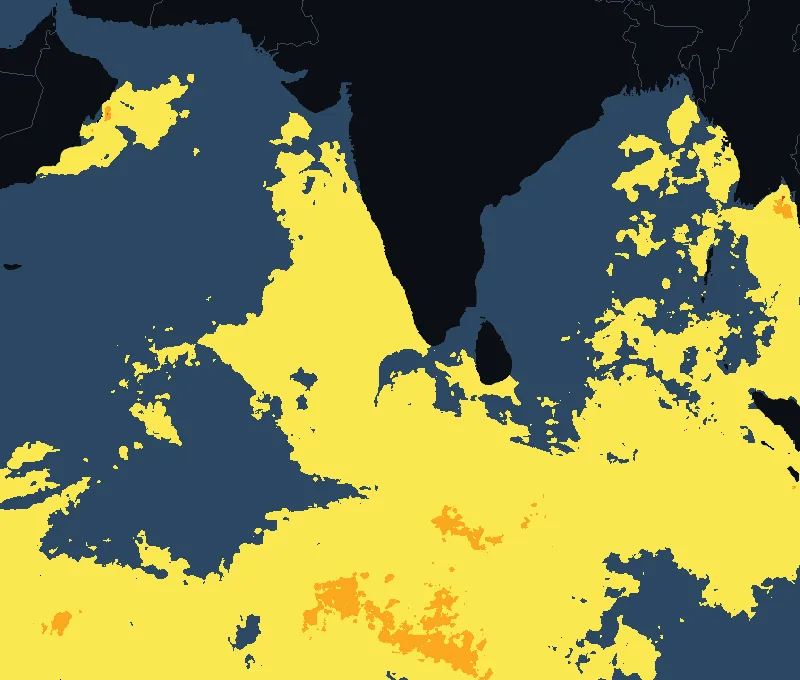 Chagos Archipelago, UKWestern IndiaKerala, IndiaLakshadweep, IndiaMaldivesSouthern Sri LankaSoutheastern IndiaEastern Sri LankaGulf of Kutch, IndiaGulf of Mannar
- No stress
- Bleaching Watch
- Bleaching Warning
- Alert Level 1
- Alert Level 2
- Alert Level 3
- Alert Level 4
- Alert Level 5
Open the interactive heat-stress map
Reef areas of South Asia
| Reef area | Alert today | Heat built up, 12 weeks (°C°F-weeks) | Water today | Above its summer peak | Where |
|---|---|---|---|---|---|
| Chagos Archipelago, UK | Bleaching Warning | 2.24.0 | 30.0°C86.0°F | +1.0°C+1.7°F | 6°S 72°E |
| Western India | Bleaching Watch | 0.91.6 | 29.1°C84.4°F | no | 18°N 72°E |
| Kerala, India | Bleaching Watch | 0.30.5 | 30.2°C86.4°F | +0.6°C+1.0°F | 10°N 76°E |
| Lakshadweep, India | Bleaching Watch | 0.00.0 | 30.3°C86.5°F | +0.3°C+0.5°F | 10°N 73°E |
| Maldives | Bleaching Watch | 0.00.0 | 29.9°C85.7°F | +0.3°C+0.5°F | 3°N 73°E |
| Southern Sri Lanka | Bleaching Watch | 0.00.0 | 29.6°C85.2°F | +0.1°C+0.2°F | 6°N 81°E |
| Southeastern India | No stress | 0.30.5 | 28.6°C83.4°F | no | 12°N 80°E |
| Eastern Sri Lanka | No stress | 0.00.0 | 29.0°C84.2°F | no | 8°N 82°E |
| Gulf of Kutch, India | No stress | 0.00.0 | 28.1°C82.5°F | no | 22°N 70°E |
| Gulf of Mannar | No stress | 0.00.0 | 28.9°C84.1°F | no | 9°N 79°E |
Source: NOAA Coral Reef Watch
Values for each reef area as NOAA Coral Reef Watch publishes them for its virtual stations. Heat stress is a risk of bleaching, not a report of bleached corals. What the alert levels mean.
The Maldives, Sri Lanka, India and Chagos
NOAA Coral Reef Watch follows ten reef areas around the tip of India: the Maldives and, further south, the Chagos Archipelago; India’s Lakshadweep islands, the coasts of Kerala and western India and the Gulf of Kutch on the Arabian Sea side; the Gulf of Mannar between India and Sri Lanka and India’s south-east coast; and the southern and eastern coasts of Sri Lanka. India’s Andaman and Nicobar Islands are counted with Southeast Asia.
The Maldives
In 1998 a marine heatwave killed more than 90% of the corals on the shallow Maldivian reefs that scientists had surveyed since 1997, and those reefs needed 16 years to regain their earlier coral cover. The heatwave of 2016 struck every surveyed reef again, but fewer corals died than in 1998.
Chagos
In the Chagos Archipelago the heat of 2015 and 2016 cut coral cover from 40–50% to under 10%, and commonly to about 5% in water shallower than 15 m49 ft. Bleaching struck the archipelago again in 2024, with smaller losses.