

Brazil: coral bleaching heat stress
How close the corals of Brazil are to bleaching: NOAA satellites compare the water at its 7 reef areas with each reef's normal summer peak, add up the extra heat over the last 12 weeks and give each reef an alert level. Figures for November 20, 2026, updated once a day. How to read it
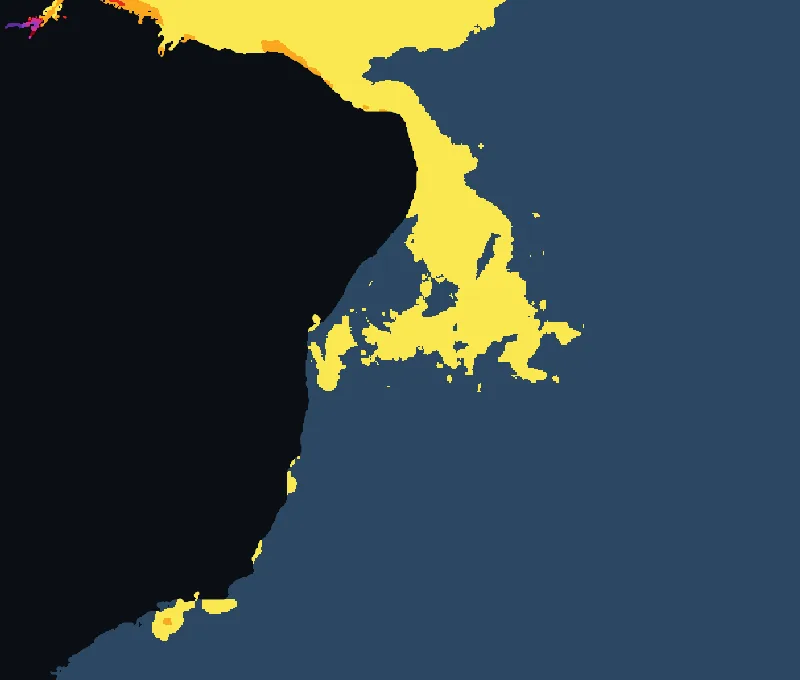 Costa dos Corais, BrazilMaracajau, BrazilTodos os Santos, BrazilAbrolhos Reefs, BrazilBuzios, BrazilFernando de Noronha, BrazilTrinadade and Martim Vaz, Brazil
- No stress
- Bleaching Watch
- Bleaching Warning
- Alert Level 1
- Alert Level 2
- Alert Level 3
- Alert Level 4
- Alert Level 5
Open the interactive heat-stress map
Reef areas of Brazil
| Reef area | Alert today | Heat built up, 12 weeks (°C°F-weeks) | Water today | Above its summer peak | Where |
|---|---|---|---|---|---|
| Costa dos Corais, Brazil | Bleaching Watch | 0.00.0 | 28.4°C83.1°F | +0.1°C+0.3°F | 9°S 36°W |
| Maracajau, Brazil | Bleaching Watch | 0.00.0 | 29.0°C84.3°F | +0.8°C+1.4°F | 6°S 35°W |
| Todos os Santos, Brazil | Bleaching Watch | 0.00.0 | 28.5°C83.2°F | +0.4°C+0.7°F | 13°S 38°W |
| Abrolhos Reefs, Brazil | No stress | 0.00.0 | 26.9°C80.4°F | no | 17°S 39°W |
| Buzios, Brazil | No stress | 0.00.0 | 24.5°C76.2°F | no | 23°S 42°W |
| Fernando de Noronha, Brazil | No stress | 0.00.0 | 28.0°C82.3°F | no | 4°S 33°W |
| Trinadade and Martim Vaz, Brazil | No stress | 0.00.0 | 25.6°C78.1°F | no | 20°S 29°W |
Source: NOAA Coral Reef Watch
Values for each reef area as NOAA Coral Reef Watch publishes them for its virtual stations. Heat stress is a risk of bleaching, not a report of bleached corals. What the alert levels mean.
The reefs of the South Atlantic
NOAA Coral Reef Watch follows seven Brazilian reef areas: Maracajaú and the Costa dos Corais in the north-east; the Bay of All Saints at Salvador; the Abrolhos Bank off southern Bahia; Búzios near Rio de Janeiro; and the oceanic islands of Fernando de Noronha and Trindade and Martim Vaz. The Abrolhos Bank holds the largest and richest coral reefs in the South Atlantic. Several of its corals live nowhere else, among them Mussismilia braziliensis, the main reef builder, found mostly off the state of Bahia.
2019 and 2024
In 2019 the strongest marine heatwave at Abrolhos since 1985 bleached most of its coral species. About 90% of the bleached fire coral died, while about 90% of the bleached Mussismilia braziliensis colonies recovered. In early 2024 the heat hit the north-east coast: bleaching reached 96% of the corals at Maragogi in Alagoas and 84% at Porto de Galinhas in Pernambuco, and at Tamandaré every monitored colony of Brazil’s endemic fire coral bleached and lost all of its living tissue.