

Caribbean: coral bleaching heat stress
How close the corals of the Caribbean are to bleaching: NOAA satellites compare the water at its 25 reef areas with each reef's normal summer peak, add up the extra heat over the last 12 weeks and give each reef an alert level. Figures for November 20, 2026, updated once a day. How to read it
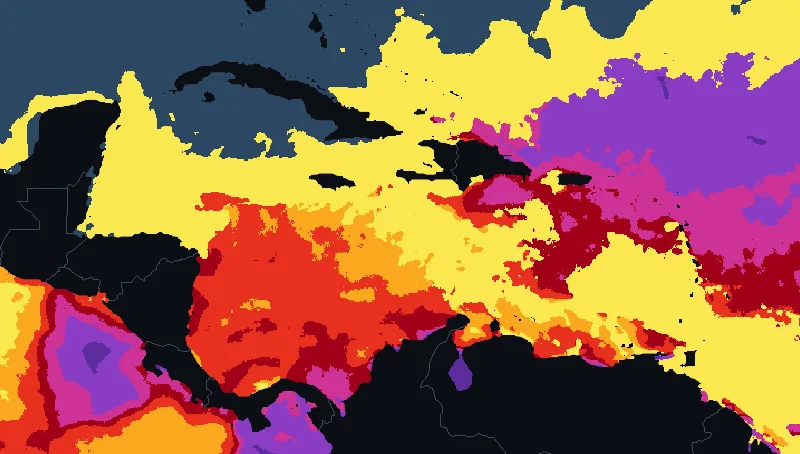 Colombia AtlanticNorthern HispaniolaLeeward Caribbean IslandsVirgin IslandsPuerto RicoSouthern HispaniolaPanama Atlantic EastNicaraguaLa Guajira, ColombiaNearshore VenezuelaWindward Caribbean IslandsPanama Atlantic WestJamaicaCosta Rica AtlanticOffshore VenezuelaAruba, Curacao, and BonaireTrinidad and TobagoNortheastern CubaBelizeHondurasQuintana Roo, MexicoSoutheastern CubaCayman IslandsSouthwestern CubaNorthwestern Cuba
- No stress
- Bleaching Watch
- Bleaching Warning
- Alert Level 1
- Alert Level 2
- Alert Level 3
- Alert Level 4
- Alert Level 5
Open the interactive heat-stress map
Reef areas of the Caribbean
| Reef area | Alert today | Heat built up, 12 weeks (°C°F-weeks) | Water today | Above its summer peak | Where |
|---|---|---|---|---|---|
| Colombia Atlantic | Alert Level 4 | 17.130.8 | 30.0°C86.0°F | +1.5°C+2.7°F | 10°N 76°W |
| Northern Hispaniola | Alert Level 4 | 16.730.1 | 29.6°C85.2°F | +1.2°C+2.2°F | 19°N 71°W |
| Leeward Caribbean Islands | Alert Level 4 | 16.429.5 | 29.3°C84.8°F | +1.1°C+2.0°F | 17°N 62°W |
| Virgin Islands | Alert Level 4 | 16.329.3 | 29.5°C85.2°F | +1.1°C+1.9°F | 18°N 65°W |
| Puerto Rico | Alert Level 3 | 15.227.3 | 29.5°C85.1°F | +1.1°C+1.9°F | 18°N 67°W |
| Southern Hispaniola | Alert Level 3 | 14.926.9 | 29.5°C85.1°F | +1.0°C+1.7°F | 19°N 72°W |
| Panama Atlantic East | Alert Level 3 | 14.826.7 | 29.9°C85.8°F | +1.3°C+2.4°F | 9°N 79°W |
| Nicaragua | Alert Level 3 | 13.324.0 | 29.7°C85.5°F | +1.4°C+2.5°F | 14°N 82°W |
| La Guajira, Colombia | Alert Level 3 | 13.023.4 | 29.1°C84.4°F | +1.1°C+1.9°F | 12°N 72°W |
| Nearshore Venezuela | Alert Level 3 | 12.522.6 | 28.0°C82.5°F | +0.9°C+1.7°F | 11°N 66°W |
| Windward Caribbean Islands | Alert Level 3 | 12.021.7 | 29.4°C84.9°F | +1.1°C+1.9°F | 13°N 60°W |
| Panama Atlantic West | Alert Level 2 | 9.717.4 | 29.9°C85.9°F | +1.4°C+2.5°F | 9°N 82°W |
| Jamaica | Alert Level 2 | 8.615.5 | 29.5°C85.1°F | +0.8°C+1.5°F | 18°N 77°W |
| Costa Rica Atlantic | Alert Level 1 | 7.112.8 | 29.6°C85.2°F | +1.2°C+2.1°F | 10°N 83°W |
| Offshore Venezuela | Alert Level 1 | 6.712.1 | 28.6°C83.6°F | +1.1°C+2.0°F | 11°N 65°W |
| Aruba, Curacao, and Bonaire | Alert Level 1 | 5.29.4 | 28.6°C83.5°F | +0.8°C+1.5°F | 12°N 69°W |
| Trinidad and Tobago | Bleaching Watch | 11.721.0 | 29.0°C84.1°F | +0.6°C+1.1°F | 11°N 61°W |
| Northeastern Cuba | Bleaching Watch | 11.420.4 | 29.4°C85.0°F | +0.5°C+0.9°F | 21°N 76°W |
| Belize | Bleaching Watch | 10.619.1 | 29.0°C84.2°F | +0.2°C+0.4°F | 17°N 88°W |
| Honduras | Bleaching Watch | 10.318.6 | 29.3°C84.7°F | +0.5°C+0.9°F | 17°N 86°W |
| Quintana Roo, Mexico | Bleaching Watch | 9.717.5 | 29.1°C84.4°F | +0.3°C+0.6°F | 20°N 87°W |
| Southeastern Cuba | Bleaching Watch | 8.815.8 | 29.3°C84.8°F | +0.1°C+0.3°F | 21°N 77°W |
| Cayman Islands | Bleaching Watch | 7.012.6 | 29.1°C84.4°F | no | 20°N 81°W |
| Southwestern Cuba | No stress | 8.014.3 | 29.0°C84.1°F | no | 22°N 82°W |
| Northwestern Cuba | No stress | 7.713.8 | 28.8°C83.9°F | no | 23°N 81°W |
Source: NOAA Coral Reef Watch
Values for each reef area as NOAA Coral Reef Watch publishes them for its virtual stations. Heat stress is a risk of bleaching, not a report of bleached corals. What the alert levels mean.
From the Mesoamerican Reef to the Lesser Antilles
NOAA Coral Reef Watch follows 25 reef areas around the Caribbean Sea: the coast of Quintana Roo in Mexico, Belize, Honduras, Nicaragua, Costa Rica, Panama and Colombia on the mainland side; Cuba, Hispaniola, Jamaica, the Cayman Islands, Puerto Rico and the Virgin Islands in the north; and the arc of the Lesser Antilles, Aruba, Curaçao and Bonaire, Venezuela and Trinidad and Tobago in the south and east. The longest single system is the Mesoamerican Reef, the second-largest barrier reef in the world, which runs for about 1,000 km620 mi from the tip of the Yucatán Peninsula past Belize and Guatemala to Honduras.
When the heat builds
Caribbean water is warmest in late summer and early autumn: over 2003 to 2025 it averaged 29.8°C85.6°F at Montego Bay and 29.2°C84.6°F at Cancún in September. Bleaching alerts usually build from July and peak between August and October.
2005 and 2023
In 2005 the heat stress across the region was greater than any measured in the previous twenty years, and the bleaching was the most severe recorded in the Caribbean until then: at many sites more than 80 percent of the corals bleached and more than 40 percent died. In 2023 the sea ran 1°C to 3°C1.8°F to 5.4°F warmer than normal from March, and in parts of the Caribbean, around Haiti, Jamaica, Nicaragua, Honduras and Costa Rica, the unusual heat lasted more than five months, the longest on record there. That season became part of the fourth global coral bleaching event, confirmed by NOAA in April 2024.