

Melanesia: coral bleaching heat stress
How close the corals of Melanesia are to bleaching: NOAA satellites compare the water at its 8 reef areas with each reef's normal summer peak, add up the extra heat over the last 12 weeks and give each reef an alert level. Figures for November 20, 2026, updated once a day. How to read it
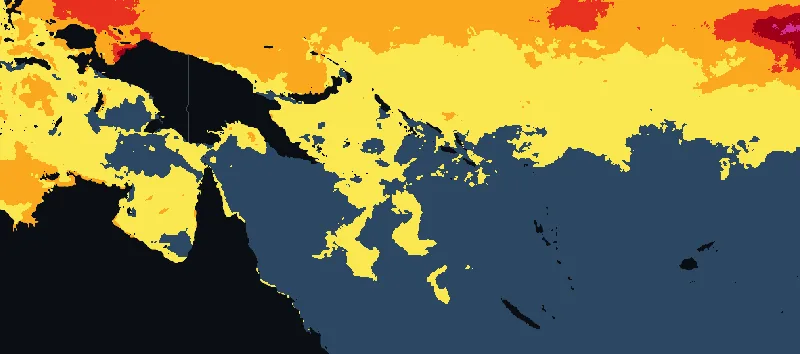 West PapuaPapua New GuineaSolomon IslandsChesterfield IslandsEastern New CaledoniaFijiVanuatuWestern New Caledonia
- No stress
- Bleaching Watch
- Bleaching Warning
- Alert Level 1
- Alert Level 2
- Alert Level 3
- Alert Level 4
- Alert Level 5
Open the interactive heat-stress map
Reef areas of Melanesia
| Reef area | Alert today | Heat built up, 12 weeks (°C°F-weeks) | Water today | Above its summer peak | Where |
|---|---|---|---|---|---|
| West Papua | Alert Level 1 | 4.68.2 | 30.8°C87.4°F | +1.4°C+2.5°F | 2°S 134°E |
| Papua New Guinea | Bleaching Warning | 0.91.7 | 30.3°C86.5°F | +0.8°C+1.5°F | 6°S 151°E |
| Solomon Islands | Bleaching Watch | 0.00.0 | 29.4°C85.0°F | +0.2°C+0.3°F | 9°S 162°E |
| Chesterfield Islands | No stress | 0.00.0 | 26.9°C80.5°F | no | 20°S 159°E |
| Eastern New Caledonia | No stress | 0.00.0 | 26.4°C79.5°F | no | 21°S 166°E |
| Fiji | No stress | 0.00.0 | 26.9°C80.4°F | no | 17°S 179°E |
| Vanuatu | No stress | 0.00.0 | 28.3°C83.0°F | no | 17°S 168°E |
| Western New Caledonia | No stress | 0.00.0 | 25.7°C78.2°F | no | 21°S 165°E |
Source: NOAA Coral Reef Watch
Values for each reef area as NOAA Coral Reef Watch publishes them for its virtual stations. Heat stress is a risk of bleaching, not a report of bleached corals. What the alert levels mean.
From New Guinea to Fiji
NOAA Coral Reef Watch follows eight reef areas in Melanesia: West Papua in Indonesia; Papua New Guinea; the Solomon Islands; Vanuatu; eastern and western New Caledonia and its remote Chesterfield Islands; and Fiji. Papua New Guinea and the Solomon Islands are also part of the Coral Triangle, the region with the most coral species in the world.
New Caledonia
New Caledonia’s barrier reef runs for about 1,500 km930 mi around the main island. Its lagoons and reefs became a UNESCO World Heritage Site in 2008, covering more than 23,400 square kilometers (9,000 square miles) of lagoon.
Fiji
Fiji’s corals bleached heavily in 2000. In early 2016 the heat returned, and by mid-February it had killed 25% to 30% of the corals on the shallow reef flats of the Coral Coast near Sigatoka, the worst die-off there since 2000.