

Red Sea and Arabian Gulf: coral bleaching heat stress
How close the corals of the Red Sea and Arabian Gulf are to bleaching: NOAA satellites compare the water at its 19 reef areas with each reef's normal summer peak, add up the extra heat over the last 12 weeks and give each reef an alert level. Figures for November 20, 2026, updated once a day. How to read it
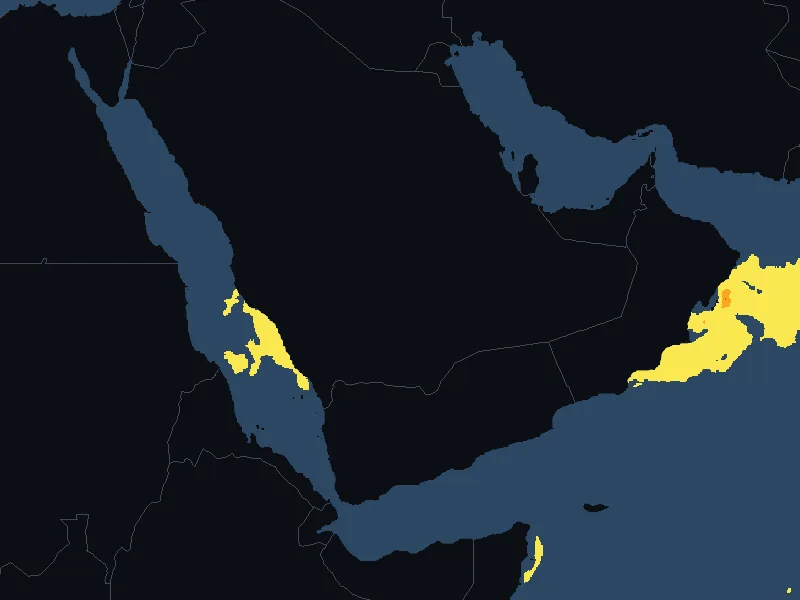 Jazan, Saudi ArabiaAl Madinah and MakkahDhofar, OmanAl Wusta, OmanEritreaWestern YemenGulf of Tadjoura, DjuboutiWestern Persian GulfSudanEgyptGulf of SuezAden, YemenEastern Persian GulfGulf of AqabaBahrainGulf of OmanTabuk, Saudi ArabiaEastern YemenSocotra, Yemen
- No stress
- Bleaching Watch
- Bleaching Warning
- Alert Level 1
- Alert Level 2
- Alert Level 3
- Alert Level 4
- Alert Level 5
Open the interactive heat-stress map
Reef areas of the Red Sea and Arabian Gulf
| Reef area | Alert today | Heat built up, 12 weeks (°C°F-weeks) | Water today | Above its summer peak | Where |
|---|---|---|---|---|---|
| Jazan, Saudi Arabia | Bleaching Watch | 16.129.1 | 31.4°C88.4°F | no | 17°N 42°E |
| Al Madinah and Makkah | Bleaching Watch | 13.925.0 | 31.8°C89.2°F | +0.3°C+0.5°F | 21°N 39°E |
| Dhofar, Oman | Bleaching Watch | 4.98.8 | 28.1°C82.6°F | +0.1°C+0.2°F | 17°N 56°E |
| Al Wusta, Oman | Bleaching Watch | 4.58.0 | 28.3°C83.0°F | +0.6°C+1.0°F | 20°N 58°E |
| Eritrea | No stress | 11.220.2 | 30.5°C86.9°F | no | 16°N 41°E |
| Western Yemen | No stress | 10.418.7 | 28.3°C82.9°F | no | 14°N 43°E |
| Gulf of Tadjoura, Djubouti | No stress | 8.214.7 | 29.4°C85.0°F | no | 12°N 43°E |
| Western Persian Gulf | No stress | 7.313.1 | 27.6°C81.6°F | no | 28°N 49°E |
| Sudan | No stress | 7.012.6 | 30.0°C85.9°F | no | 20°N 38°E |
| Egypt | No stress | 5.910.7 | 27.7°C81.8°F | no | 24°N 36°E |
| Gulf of Suez | No stress | 5.29.3 | 26.1°C79.0°F | no | 28°N 33°E |
| Aden, Yemen | No stress | 4.68.3 | 28.5°C83.2°F | no | 13°N 45°E |
| Eastern Persian Gulf | No stress | 4.17.4 | 29.6°C85.2°F | no | 26°N 54°E |
| Gulf of Aqaba | No stress | 3.86.8 | 25.1°C77.1°F | no | 29°N 35°E |
| Bahrain | No stress | 3.66.4 | 28.0°C82.3°F | no | 26°N 51°E |
| Gulf of Oman | No stress | 2.03.6 | 28.0°C82.4°F | no | 24°N 59°E |
| Tabuk, Saudi Arabia | No stress | 1.93.5 | 28.8°C83.8°F | no | 26°N 36°E |
| Eastern Yemen | No stress | 1.52.6 | 28.4°C83.0°F | no | 14°N 50°E |
| Socotra, Yemen | No stress | 0.00.0 | 28.6°C83.4°F | no | 12°N 53°E |
Source: NOAA Coral Reef Watch
Values for each reef area as NOAA Coral Reef Watch publishes them for its virtual stations. Heat stress is a risk of bleaching, not a report of bleached corals. What the alert levels mean.
From the Gulf of Aqaba to the Gulf of Oman
NOAA Coral Reef Watch follows 19 reef areas around the Arabian Peninsula: the Red Sea, from the Gulfs of Suez and Aqaba along the coasts of Egypt, Sudan, Eritrea, Saudi Arabia and Yemen; the Gulf of Aden, with Djibouti, Aden and Socotra; the coast of Oman; and the Gulf between Arabia and Iran, called the Persian Gulf or the Arabian Gulf. Fringing reefs run almost the whole length of both Red Sea coasts, less so in the south, and Egypt alone has more than 1,800 km1,100 mi of coral reef habitat.
Corals in some of the hottest water
The corals of the Gulf live with summer water above 35°C95°F every year and winter water as cool as 13°C55°F. Off Dubai the sea averaged 33.5°C92.3°F in August over 2003 to 2025. Even these corals bleach when the heat lasts: mass bleaching struck the southern Gulf in 1998, 2010 and 2012, when about 40% of the corals on reefs off Abu Dhabi bleached, and again from 2017 to 2020.
The Gulf of Aqaba
At the northern tip of the Red Sea, the corals of the Gulf of Aqaba stand heat that bleaches corals elsewhere. Scientists think the hot southern Red Sea, which their ancestors had to cross, selected corals that tolerate heat, and see the gulf as a possible refuge for reefs as the oceans warm. Bleaching was recorded there for the first time in the summer of 2024, when the heat built up to nearly eight times the level at which bleaching usually begins. Only about 5% of the corals off Eilat bleached, and most of them recovered. Further south, extreme heat in 2023 and 2024 caused severe bleaching across the Red Sea and the Gulf of Aden.