

Florida: coral bleaching heat stress
How close the corals of Florida are to bleaching: NOAA satellites compare the water at its 2 reef areas with each reef's normal summer peak, add up the extra heat over the last 12 weeks and give each reef an alert level. Figures for November 20, 2026, updated once a day. How to read it
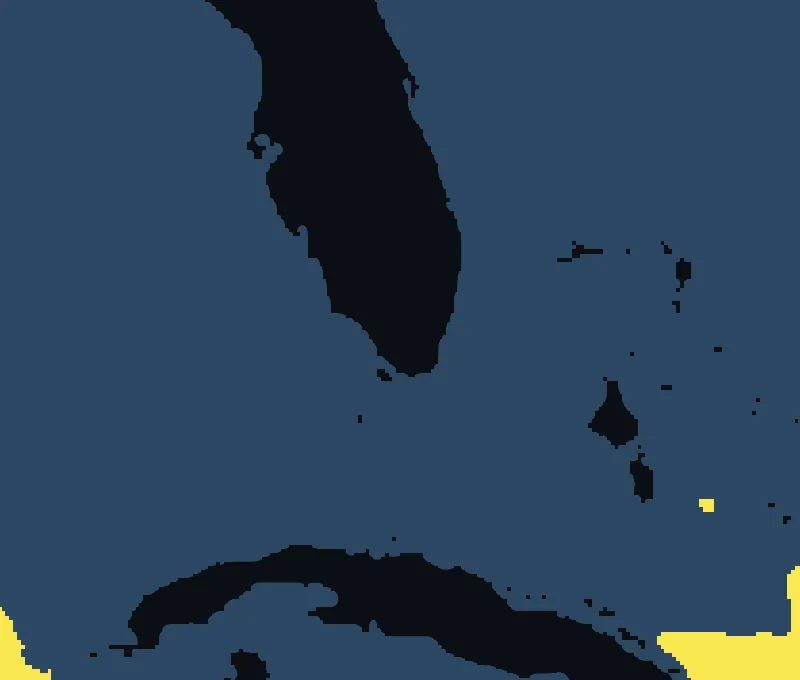 Florida KeysSoutheast Florida
- No stress
- Bleaching Watch
- Bleaching Warning
- Alert Level 1
- Alert Level 2
- Alert Level 3
- Alert Level 4
- Alert Level 5
Open the interactive heat-stress map
Reef areas of Florida
| Reef area | Alert today | Heat built up, 12 weeks (°C°F-weeks) | Water today | Above its summer peak | Where |
|---|---|---|---|---|---|
| Florida Keys | No stress | 6.912.4 | 27.8°C82.0°F | no | 25°N 82°W |
| Southeast Florida | No stress | 4.98.9 | 27.8°C82.0°F | no | 26°N 80°W |
Source: NOAA Coral Reef Watch
Values for each reef area as NOAA Coral Reef Watch publishes them for its virtual stations. Heat stress is a risk of bleaching, not a report of bleached corals. What the alert levels mean.
The only extensive shallow coral reef of the mainland United States
Florida’s Coral Reef runs for about 563 km350 mi, from the Dry Tortugas west of Key West along the Florida Keys and up the Atlantic coast past Miami to St. Lucie Inlet. NOAA Coral Reef Watch follows it as two reef areas: the Florida Keys, from the Dry Tortugas to Key Largo, and Southeast Florida, the reefs along the Atlantic coast north of the Keys.
When the heat builds
The water over the reef is warmest in August, when it averages 30.6°C87.1°F at Key West and 30.4°C86.7°F at Key Largo over 2003 to 2025. Corals here live close to the top of what they can bear in late summer, so a few weeks of water warmer than usual from July to September is enough to raise a bleaching alert; in winter the alerts fall back to no stress.
The 2023 marine heatwave
In 2023 the water around the Keys turned record-hot in June, weeks earlier than usual, and the Florida Keys reached Alert Level 2 about six weeks earlier than in a normal year. The heat stress went so far past the old top of the scale that NOAA added Alert Levels 3 to 5 to it later that year. A later study found that 98 to 100 percent of the elkhorn and staghorn corals at the sites it followed died, which its authors called the functional extinction of the two species there. Florida’s bleaching was part of the fourth global coral bleaching event, which NOAA confirmed in April 2024.