

Eastern Pacific: coral bleaching heat stress
How close the corals of the Eastern Pacific are to bleaching: NOAA satellites compare the water at its 7 reef areas with each reef's normal summer peak, add up the extra heat over the last 12 weeks and give each reef an alert level. Figures for November 20, 2026, updated once a day. How to read it
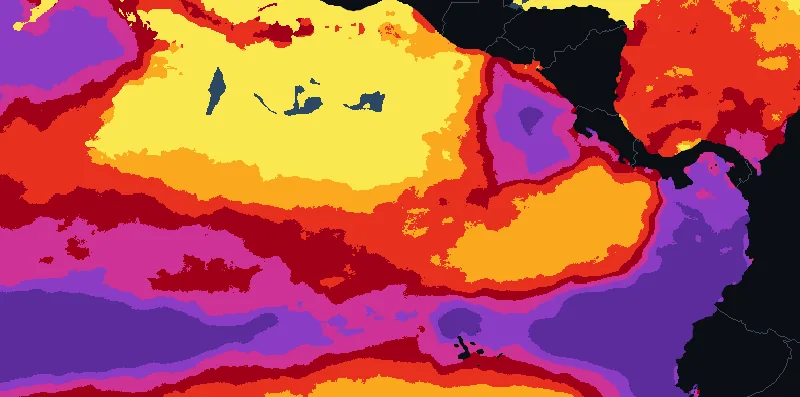 Galapagos, EcuadorPanama Pacific EastCosta Rica PacificPanama Pacific WestEl SalvadorClipperton Island, FranceIsla del Coco, Costa Rica
- No stress
- Bleaching Watch
- Bleaching Warning
- Alert Level 1
- Alert Level 2
- Alert Level 3
- Alert Level 4
- Alert Level 5
Open the interactive heat-stress map
Reef areas of the Eastern Pacific
| Reef area | Alert today | Heat built up, 12 weeks (°C°F-weeks) | Water today | Above its summer peak | Where |
|---|---|---|---|---|---|
| Galapagos, Ecuador | Alert Level 5 | 21.739.1 | 29.1°C84.3°F | +2.9°C+5.2°F | 0°N 91°W |
| Panama Pacific East | Alert Level 4 | 19.234.5 | 29.6°C85.4°F | +1.7°C+3.1°F | 8°N 79°W |
| Costa Rica Pacific | Alert Level 4 | 16.930.5 | 31.0°C87.8°F | +1.9°C+3.4°F | 10°N 84°W |
| Panama Pacific West | Alert Level 4 | 16.129.0 | 30.3°C86.6°F | +1.9°C+3.5°F | 8°N 82°W |
| El Salvador | Alert Level 1 | 7.112.8 | 30.9°C87.6°F | +1.3°C+2.3°F | 13°N 88°W |
| Clipperton Island, France | Alert Level 1 | 6.010.9 | 29.8°C85.6°F | +1.0°C+1.8°F | 10°N 109°W |
| Isla del Coco, Costa Rica | Bleaching Warning | 2.03.7 | 30.4°C86.6°F | +1.4°C+2.5°F | 6°N 87°W |
Source: NOAA Coral Reef Watch
Values for each reef area as NOAA Coral Reef Watch publishes them for its virtual stations. Heat stress is a risk of bleaching, not a report of bleached corals. What the alert levels mean.
Reefs off the Pacific coast of the Americas
NOAA Coral Reef Watch follows seven reef areas in the eastern tropical Pacific: the Pacific coasts of El Salvador, Costa Rica and Panama, which counts as two areas, and the offshore islands of Isla del Coco (Costa Rica), the Galápagos (Ecuador) and Clipperton (France). Clipperton is the only atoll in the eastern Pacific, and the reef on its outer slopes is the largest in the region; a 2019 survey found half or more of it covered in living coral, mostly massive Porites.
Where El Niño strikes first
No reefs feel El Niño more directly than these. In an El Niño the warm water that normally sits in the western Pacific spreads east along the equator, and the eastern Pacific, usually cooled by upwelling, turns hot. The 1982–83 El Niño killed between half and nearly all of the corals across the eastern equatorial Pacific, 52% to 97% depending on the place, many more than in the strong El Niño of 1997–98.
The Galápagos
In the Galápagos the 1982–83 event killed 95% of the living coral. Of the 17 reefs that scientists had mapped there in the mid-1970s, only Wellington Reef at Darwin Island, in the far north of the archipelago, is still growing; the others have broken down into scattered coral communities or disappeared.