

Polynesia: coral bleaching heat stress
How close the corals of Polynesia are to bleaching: NOAA satellites compare the water at its 17 reef areas with each reef's normal summer peak, add up the extra heat over the last 12 weeks and give each reef an alert level. Figures for November 20, 2026, updated once a day. How to read it
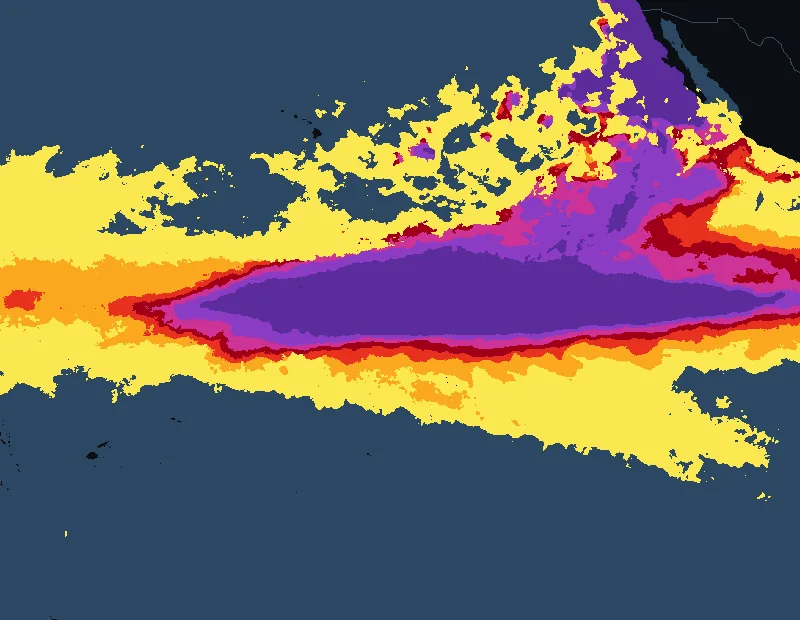 Northern Line IslandsSouthern Line IslandsMarquesas IslandsNorthern Cook IslandsTuvaluMain Hawaiian IslandsAustral IslandsEaster Island, ChileNorthern TongaNorthwestern Hawaiian IslandsPitcairn IslandsSamoasSociety ArchipelagoSouthern Cook IslandsSouthern TongaTuamotu ArchipelagoWallis and Futuna
- No stress
- Bleaching Watch
- Bleaching Warning
- Alert Level 1
- Alert Level 2
- Alert Level 3
- Alert Level 4
- Alert Level 5
Open the interactive heat-stress map
Reef areas of Polynesia
| Reef area | Alert today | Heat built up, 12 weeks (°C°F-weeks) | Water today | Above its summer peak | Where |
|---|---|---|---|---|---|
| Northern Line Islands | Alert Level 5 | 26.848.2 | 29.9°C85.9°F | +2.2°C+3.9°F | 3°N 160°W |
| Southern Line Islands | Alert Level 4 | 19.535.2 | 30.5°C86.8°F | +1.8°C+3.2°F | 8°S 153°W |
| Marquesas Islands | Bleaching Watch | 0.00.0 | 29.8°C85.6°F | +0.9°C+1.7°F | 9°S 140°W |
| Northern Cook Islands | Bleaching Watch | 0.00.0 | 29.5°C85.1°F | +0.1°C+0.1°F | 11°S 165°W |
| Tuvalu | Bleaching Watch | 0.00.0 | 30.0°C86.1°F | +0.4°C+0.7°F | 8°S 178°E |
| Main Hawaiian Islands | No stress | 0.10.3 | 26.3°C79.3°F | no | 21°N 158°W |
| Austral Islands | No stress | 0.00.0 | 23.1°C73.7°F | no | 25°S 149°W |
| Easter Island, Chile | No stress | 0.00.0 | 21.0°C69.8°F | no | 27°S 109°W |
| Northern Tonga | No stress | 0.00.0 | 27.3°C81.1°F | no | 16°S 175°W |
| Northwestern Hawaiian Islands | No stress | 0.00.0 | 25.8°C78.4°F | no | 26°N 170°W |
| Pitcairn Islands | No stress | 0.00.0 | 22.3°C72.1°F | no | 24°S 130°W |
| Samoas | No stress | 0.00.0 | 28.0°C82.4°F | no | 13°S 170°W |
| Society Archipelago | No stress | 0.00.0 | 26.8°C80.3°F | no | 17°S 151°W |
| Southern Cook Islands | No stress | 0.00.0 | 25.6°C78.0°F | no | 20°S 164°W |
| Southern Tonga | No stress | 0.00.0 | 25.0°C76.9°F | no | 20°S 175°W |
| Tuamotu Archipelago | No stress | 0.00.0 | 27.8°C82.0°F | no | 19°S 142°W |
| Wallis and Futuna | No stress | 0.00.0 | 28.3°C82.8°F | no | 14°S 177°W |
Source: NOAA Coral Reef Watch
Values for each reef area as NOAA Coral Reef Watch publishes them for its virtual stations. Heat stress is a risk of bleaching, not a report of bleached corals. What the alert levels mean.
From Hawaii to Easter Island
NOAA Coral Reef Watch groups 17 reef areas of the central and eastern Pacific as Polynesia: the main and the northwestern Hawaiian Islands; the Line Islands of Kiribati on the equator; Tuvalu, Wallis and Futuna, Samoa, Tonga and the Cook Islands; the Society, Tuamotu, Marquesas and Austral islands of French Polynesia; the Pitcairn Islands; and Easter Island. The reefs north of the equator, such as Hawaii, warm most from August to October, and those south of it from February to April.
Hawaii
Coral bleaching was rare in Hawaii, recorded only in 1996, until the islands went through two bleaching events in consecutive summers, 2014 and 2015. In 2015 the west coast of the Big Island had the most severe heat stress of the main islands, and about half of the coral that bleached severely there died in the months that followed. A third major episode came in 2019, milder across the islands than the first two. The water at Waikiki averaged 26.9°C80.4°F in September, its warmest month, over 2003 to 2025.
The Line Islands and El Niño
The reefs near the equator feel El Niño most. During the 2015–2016 El Niño the water around Kiritimati, or Christmas Island, ran 1.5°C to 3°C2.7°F to 5.4°F above normal for about ten months, and close to 90 percent of the atoll’s coral cover was lost, which the researchers who followed it described as the largest coral die-off recorded at a single place.