

Gulf of Mexico: coral bleaching heat stress
How close the corals of the Gulf of Mexico are to bleaching: NOAA satellites compare the water at its 3 reef areas with each reef's normal summer peak, add up the extra heat over the last 12 weeks and give each reef an alert level. Figures for November 20, 2026, updated once a day. How to read it
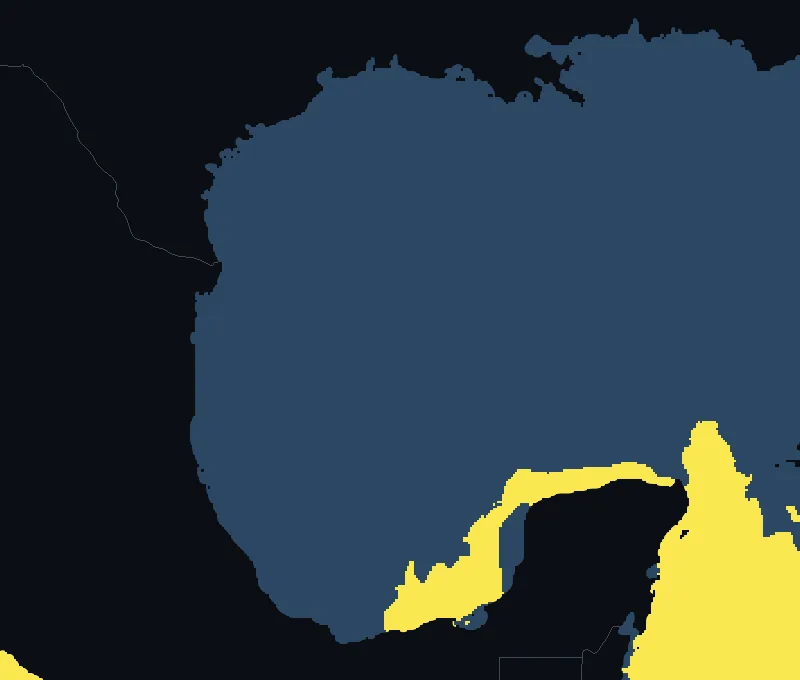 Yucatan PeninsulaVeracruz, MexicoFlower Garden Banks, Texas
- No stress
- Bleaching Watch
- Bleaching Warning
- Alert Level 1
- Alert Level 2
- Alert Level 3
- Alert Level 4
- Alert Level 5
Open the interactive heat-stress map
Reef areas of the Gulf of Mexico
| Reef area | Alert today | Heat built up, 12 weeks (°C°F-weeks) | Water today | Above its summer peak | Where |
|---|---|---|---|---|---|
| Yucatan Peninsula | Bleaching Watch | 15.728.2 | 27.6°C81.7°F | no | 21°N 90°W |
| Veracruz, Mexico | No stress | 11.621.0 | 27.5°C81.5°F | no | 20°N 96°W |
| Flower Garden Banks, Texas | No stress | 3.05.4 | 25.8°C78.5°F | no | 28°N 94°W |
Source: NOAA Coral Reef Watch
Values for each reef area as NOAA Coral Reef Watch publishes them for its virtual stations. Heat stress is a risk of bleaching, not a report of bleached corals. What the alert levels mean.
Three reef areas far apart
NOAA Coral Reef Watch follows three reef areas in the Gulf of Mexico. The Flower Garden Banks lie 130 to 200 km (80 to 125 mi) off the coasts of Texas and Louisiana and are protected as a national marine sanctuary, the only one in the Gulf. The Veracruz reefs lie off the port of Veracruz on Mexico’s Gulf coast, and the third area covers the reefs on the shallow bank off the north coast of the Yucatán Peninsula.
Reefs on top of salt domes
The Flower Garden Banks are unusual: their corals grow on the tops of banks pushed up by salt domes deep below the sea floor, rising from water more than 100 m330 ft deep to within about 17 m56 ft of the surface. Much of the sanctuary lies deeper still, in the dim “twilight” zone where light-loving corals give way to other reef life.
When the heat builds
The northern Gulf warms most in August and September; over 2003 to 2025 the water averaged 30.3°C86.5°F in August at Galveston, on the coast. Bleaching alerts here build in late summer, while winter brings cooler water than the Caribbean has at any time of year.