

Coral Triangle: coral bleaching heat stress
How close the corals of the Coral Triangle are to bleaching: NOAA satellites compare the water at its 20 reef areas with each reef's normal summer peak, add up the extra heat over the last 12 weeks and give each reef an alert level. Figures for November 20, 2026, updated once a day. How to read it
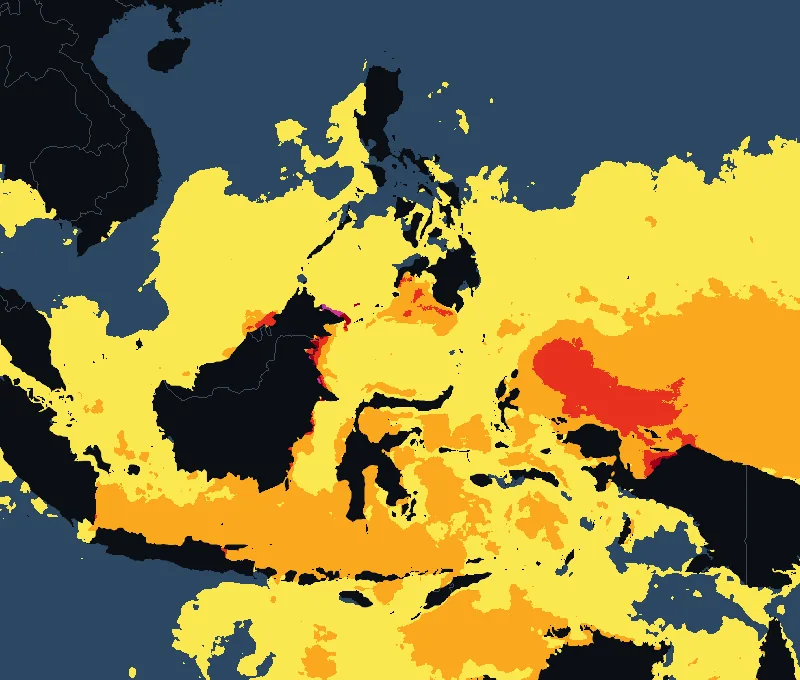 Sabah, MalaysiaSouthern PhilippinesEast KalimantanWest SulawesiWest Nusa TenggaraEast Java and BaliSouthern BorneoCentral Sulawesi and GorontaloEast Nusa TenggaraSouth SulawesiNorth Maluku, IndonesiaWest TimorSouth East SulawesiEastern PhilippinesNorthern PhilippinesWestern PhilippinesCentral PhilippinesNorth SulawesiMaluku, IndonesiaTimor-Leste
- No stress
- Bleaching Watch
- Bleaching Warning
- Alert Level 1
- Alert Level 2
- Alert Level 3
- Alert Level 4
- Alert Level 5
Open the interactive heat-stress map
Reef areas of the Coral Triangle
| Reef area | Alert today | Heat built up, 12 weeks (°C°F-weeks) | Water today | Above its summer peak | Where |
|---|---|---|---|---|---|
| Sabah, Malaysia | Alert Level 3 | 14.025.2 | 30.6°C87.2°F | +1.0°C+1.8°F | 6°N 117°E |
| Southern Philippines | Alert Level 1 | 7.012.5 | 30.1°C86.1°F | +0.8°C+1.5°F | 7°N 123°E |
| East Kalimantan | Alert Level 1 | 5.29.3 | 30.2°C86.4°F | +1.2°C+2.2°F | 1°N 118°E |
| West Sulawesi | Bleaching Warning | 3.46.2 | 30.3°C86.5°F | +0.9°C+1.7°F | 2°S 119°E |
| West Nusa Tenggara | Bleaching Warning | 2.03.6 | 30.3°C86.6°F | +1.5°C+2.6°F | 9°S 118°E |
| East Java and Bali | Bleaching Warning | 1.83.3 | 31.0°C87.8°F | +1.5°C+2.8°F | 7°S 114°E |
| Southern Borneo | Bleaching Warning | 1.52.7 | 30.8°C87.3°F | +1.4°C+2.5°F | 4°S 117°E |
| Central Sulawesi and Gorontalo | Bleaching Warning | 1.42.6 | 30.5°C86.8°F | +1.2°C+2.1°F | 1°S 123°E |
| East Nusa Tenggara | Bleaching Warning | 1.42.5 | 30.6°C87.0°F | +1.5°C+2.8°F | 9°S 122°E |
| South Sulawesi | Bleaching Warning | 1.22.2 | 30.8°C87.4°F | +1.6°C+2.9°F | 5°S 120°E |
| North Maluku, Indonesia | Bleaching Warning | 1.12.0 | 30.3°C86.5°F | +0.9°C+1.7°F | 0°N 127°E |
| West Timor | Bleaching Warning | 0.20.3 | 30.9°C87.6°F | +1.2°C+2.2°F | 10°S 124°E |
| South East Sulawesi | Bleaching Warning | 0.20.3 | 30.5°C86.9°F | +1.1°C+1.9°F | 5°S 123°E |
| Eastern Philippines | Bleaching Watch | 5.29.3 | 29.3°C84.7°F | +0.3°C+0.5°F | 11°N 124°E |
| Northern Philippines | Bleaching Watch | 3.86.8 | 29.9°C85.9°F | +0.1°C+0.2°F | 18°N 121°E |
| Western Philippines | Bleaching Watch | 2.95.2 | 29.6°C85.3°F | +0.2°C+0.3°F | 11°N 119°E |
| Central Philippines | Bleaching Watch | 2.54.4 | 29.2°C84.6°F | no | 14°N 122°E |
| North Sulawesi | Bleaching Watch | 1.73.1 | 30.1°C86.2°F | +0.6°C+1.1°F | 3°N 125°E |
| Maluku, Indonesia | Bleaching Watch | 0.00.0 | 29.9°C85.8°F | +0.7°C+1.3°F | 6°S 130°E |
| Timor-Leste | Bleaching Watch | 0.00.0 | 30.3°C86.6°F | +0.9°C+1.6°F | 8°S 127°E |
Source: NOAA Coral Reef Watch
Values for each reef area as NOAA Coral Reef Watch publishes them for its virtual stations. Heat stress is a risk of bleaching, not a report of bleached corals. What the alert levels mean.
The richest reefs on Earth
The Coral Triangle, the seas shared by Indonesia, the Philippines, Malaysia, Papua New Guinea, the Solomon Islands and Timor-Leste, is home to 76% of all known coral species and 37% of the world’s coral reef fish. NOAA Coral Reef Watch follows 20 reef areas in its western part: the northern, central, eastern, western and southern Philippines; Sulawesi, Borneo, Java and Bali, the Nusa Tenggara islands and Maluku in Indonesia; Sabah in Malaysia; and Timor-Leste. The reefs of Papua New Guinea and the Solomon Islands are counted with Melanesia.
Heat stress and staying power
Heat stress peaked here in and around 1998, 2010, 2016 and 2024, the years of the four global coral bleaching events. Many of these reefs have held up better than most: a study of 32 places in Indonesia from 2004 to 2023 found no significant change in hard coral cover at 26 of them, through the heat of 2010 and 2016 and the warmer years since 2020. The researchers warn that stability does not mean safety, because coral loss can speed up once heat stress comes too often or too strongly.