

East Asia: coral bleaching heat stress
How close the corals of East Asia are to bleaching: NOAA satellites compare the water at its 10 reef areas with each reef's normal summer peak, add up the extra heat over the last 12 weeks and give each reef an alert level. Figures for November 20, 2026, updated once a day. How to read it
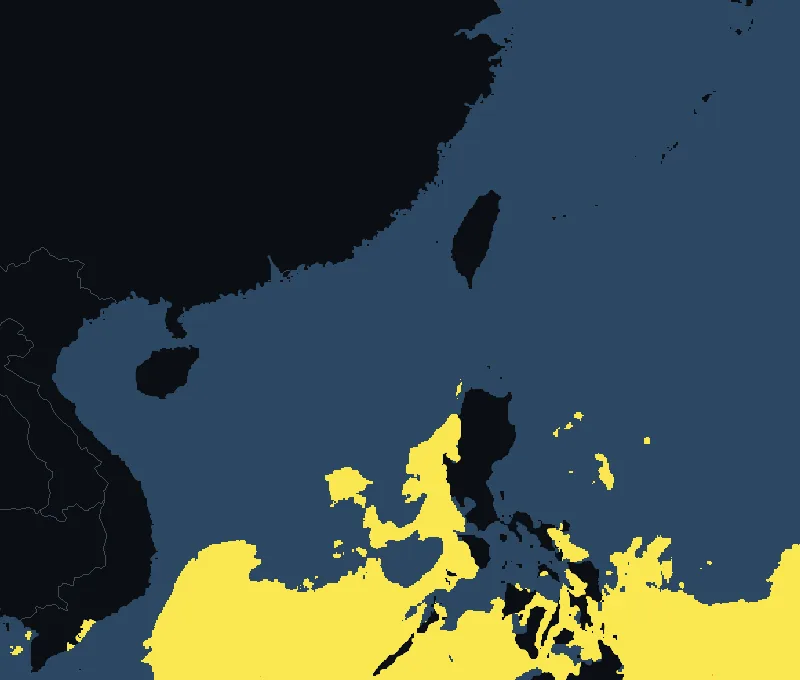 Hong Kong, ChinaHainan Island, ChinaParacel Islands, ChinaSouthern VietnamDongsha, TaiwanNorthern VietnamNorthern Ryukyu Islands, JapanNorthern TaiwanSouthern Ryukyu Islands, JapanSouthern Taiwan
- No stress
- Bleaching Watch
- Bleaching Warning
- Alert Level 1
- Alert Level 2
- Alert Level 3
- Alert Level 4
- Alert Level 5
Open the interactive heat-stress map
Reef areas of East Asia
| Reef area | Alert today | Heat built up, 12 weeks (°C°F-weeks) | Water today | Above its summer peak | Where |
|---|---|---|---|---|---|
| Hong Kong, China | No stress | 3.35.9 | 25.3°C77.5°F | no | 22°N 114°E |
| Hainan Island, China | No stress | 1.93.4 | 27.5°C81.6°F | no | 19°N 110°E |
| Paracel Islands, China | No stress | 1.83.2 | 28.6°C83.4°F | no | 16°N 112°E |
| Southern Vietnam | No stress | 1.62.9 | 28.7°C83.6°F | no | 11°N 108°E |
| Dongsha, Taiwan | No stress | 1.01.8 | 26.4°C79.5°F | no | 21°N 116°E |
| Northern Vietnam | No stress | 0.50.9 | 27.8°C82.1°F | no | 18°N 107°E |
| Northern Ryukyu Islands, Japan | No stress | 0.00.0 | 25.4°C77.8°F | no | 28°N 129°E |
| Northern Taiwan | No stress | 0.00.0 | 24.6°C76.4°F | no | 25°N 122°E |
| Southern Ryukyu Islands, Japan | No stress | 0.00.0 | 26.1°C79.0°F | no | 25°N 124°E |
| Southern Taiwan | No stress | 0.00.0 | 26.6°C79.9°F | no | 23°N 121°E |
Source: NOAA Coral Reef Watch
Values for each reef area as NOAA Coral Reef Watch publishes them for its virtual stations. Heat stress is a risk of bleaching, not a report of bleached corals. What the alert levels mean.
From Okinawa to Vietnam
NOAA Coral Reef Watch follows ten reef areas in East Asia: the northern and southern Ryukyu Islands of Japan, Okinawa among them; the north and south of Taiwan and Taiwan’s Dongsha Atoll; Hong Kong; Hainan Island; the Paracel Islands; and the north and south of Vietnam. Hong Kong’s waters alone have 84 confirmed species of stony coral.
Japan’s largest reef
In 1998 the bleaching around Okinawa was unlike anything recorded there before: at Sesoko Island it cut coral cover by 85%. In the southern Ryukyus, the Sekisei Lagoon between Ishigaki and Iriomote is Japan’s largest coral reef. After the hot summer of 2016, a survey of 35 sites by Japan’s Ministry of the Environment found that about 70% of its coral had died, and by 2018, after mass bleaching in 1998, 2001, 2007 and 2016, only 1.4% of the lagoon’s reef was still in healthy condition.
Dongsha Atoll
In June 2015 the South China Sea was about 2°C3.6°F warmer than usual, and in exceptionally calm weather, with almost no wind or waves, the water on Dongsha Atoll heated far more, to about 6°C10.8°F above normal. All of the corals there bleached and 40% of them died, in an event without equal in at least 40 years.