

Australia (outside the Great Barrier Reef): coral bleaching heat stress
How close the corals of Australia (outside the Great Barrier Reef) are to bleaching: NOAA satellites compare the water at its 17 reef areas with each reef's normal summer peak, add up the extra heat over the last 12 weeks and give each reef an alert level. Figures for November 20, 2026, updated once a day. How to read it
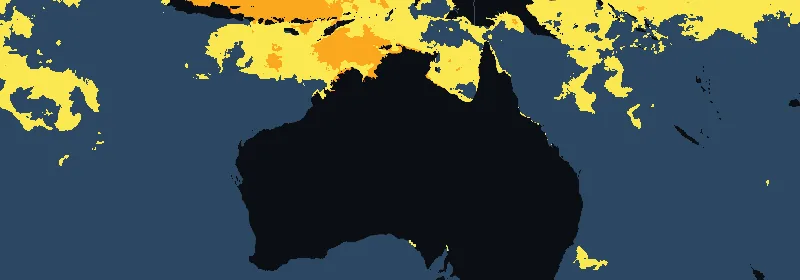 Scott to Ashmore ReefsBeagle GulfNorth Western AustraliaGulf of CarpentariaNorthern TerritoryCentral Western AustraliaChristmas Island, AustraliaHamelin PoolHoutman AbrolhosLord Howe Island, AustraliaMarmion and Rottnest IslandMoreton Bay, AustraliaNingalooNorfolk Island, AustraliaPulu Keeling, AustraliaRowley ShoalsShark Bay
- No stress
- Bleaching Watch
- Bleaching Warning
- Alert Level 1
- Alert Level 2
- Alert Level 3
- Alert Level 4
- Alert Level 5
Open the interactive heat-stress map
Reef areas of Australia (outside the Great Barrier Reef)
| Reef area | Alert today | Heat built up, 12 weeks (°C°F-weeks) | Water today | Above its summer peak | Where |
|---|---|---|---|---|---|
| Scott to Ashmore Reefs | Bleaching Warning | 3.15.7 | 30.9°C87.5°F | +1.3°C+2.3°F | 13°S 123°E |
| Beagle Gulf | Bleaching Warning | 1.93.5 | 31.9°C89.3°F | +1.3°C+2.3°F | 13°S 130°E |
| North Western Australia | Bleaching Warning | 0.30.5 | 31.0°C87.9°F | +1.0°C+1.8°F | 16°S 125°E |
| Gulf of Carpentaria | Bleaching Watch | 0.00.0 | 31.2°C88.2°F | +0.4°C+0.8°F | 15°S 139°E |
| Northern Territory | Bleaching Watch | 0.00.0 | 31.3°C88.3°F | +0.9°C+1.6°F | 11°S 134°E |
| Central Western Australia | No stress | 0.00.0 | 26.7°C80.1°F | no | 21°S 117°E |
| Christmas Island, Australia | No stress | 0.00.0 | 27.7°C81.9°F | no | 10°S 106°E |
| Hamelin Pool | No stress | 0.00.0 | 24.0°C75.3°F | no | 26°S 114°E |
| Houtman Abrolhos | No stress | 0.00.0 | 21.9°C71.4°F | no | 29°S 114°E |
| Lord Howe Island, Australia | No stress | 0.00.0 | 20.9°C69.5°F | no | 31°S 159°E |
| Marmion and Rottnest Island | No stress | 0.00.0 | 20.6°C69.2°F | no | 32°S 116°E |
| Moreton Bay, Australia | No stress | 0.00.0 | 24.8°C76.7°F | no | 27°S 154°E |
| Ningaloo | No stress | 0.00.0 | 25.2°C77.4°F | no | 23°S 114°E |
| Norfolk Island, Australia | No stress | 0.00.0 | 21.3°C70.4°F | no | 29°S 168°E |
| Pulu Keeling, Australia | No stress | 0.00.0 | 27.5°C81.5°F | no | 12°S 97°E |
| Rowley Shoals | No stress | 0.00.0 | 28.6°C83.5°F | no | 17°S 119°E |
| Shark Bay | No stress | 0.00.0 | 22.3°C72.1°F | no | 25°S 113°E |
Source: NOAA Coral Reef Watch
Values for each reef area as NOAA Coral Reef Watch publishes them for its virtual stations. Heat stress is a risk of bleaching, not a report of bleached corals. What the alert levels mean.
Reefs all around the continent
NOAA Coral Reef Watch follows 17 Australian reef areas besides the Great Barrier Reef. In Western Australia they run from Rottnest Island off Perth and the Houtman Abrolhos north through Shark Bay and Ningaloo to the Rowley Shoals and Scott and Ashmore Reefs; across the north they cover the Northern Territory, the Beagle Gulf off Darwin and the Gulf of Carpentaria; in the Indian Ocean, Christmas Island and the Cocos (Keeling) Islands; and in the east, Moreton Bay near Brisbane, Lord Howe Island and Norfolk Island. Off the Gold Coast, south of Moreton Bay, the sea averaged 26.2°C79.2°F in February, its warmest month, over 2003 to 2025.
Ningaloo and the heatwave of 2011
Ningaloo, a World Heritage site, is a fringing reef about 300 km186 mi long on the coast of Western Australia. In the summer of 2010–11 an exceptionally strong La Niña pushed warm water from Indonesia down the coast, and the sea off Ningaloo ran 1°C to 3°C1.8°F to 5.4°F above its long-term average. Corals bleached along much of the Western Australian coast, Ningaloo and the Abrolhos included, and at one site in the Ningaloo Marine Park coral cover fell by 79% to 92%.
Lord Howe Island
Lord Howe Island, in the Tasman Sea, has the southernmost coral reef in the world. Its corals bleached in 2010, up to 99% of the colonies at some shallow lagoon sites, and again in 2019, when up to 40% of the coral died in the worst-hit area near the shore.